Valspar Championship at Innisbrook Resort – 2026 Preview

Ron Klos

2 months ago

After Cam Young’s scintillating comeback win at The PLAYERS Championship, the Florida Swing concludes with the Valspar Championship. While Innisbrook has four courses available to golfers, the Copperhead course is the one that has hosted this tournament since its inception on Tour in 2000.
Located just outside of Tampa in Palm Harbor, Florida, Innisbrook is one of the most underrated courses on the PGA Tour and encompasses one of the most complete tests of golf that players will face all year. Featuring narrow pine tree-lined fairways and rolling terrain combined with the surrounding lakes, proper positioning off the tee is paramount. 2023’s champion, Taylor Moore remarked, “This place is a ball-striker’s kind of paradise – fairway and green it to death.”
Players will be challenged as they navigate numerous tight doglegs, elevation changes, 74 well-positioned bunkers, six holes with water danger, rough approaching four inches, and tricky pin positions. The course has consistently played over par and ranks as the ninth most difficult annual course on Tour.
The number of trees and elevation changes make it feel as if one is in the hill country of North Carolina. As course architect, Larry Packard, said himself back in 2012, “When you play Copperhead you don’t even feel like you are in Florida. When you stand on the first hole and look down the fairway you are on an elevated tee and looking down the fairway lined with pine trees on both sides. It feels more like the Carolinas than Florida.”
The makeup of the par-71 course is also far from traditional as there are five par-3s along with four par-5s. The course culminates at the infamous “Snake Pit” with two difficult par-4s sandwiched between the challenging par-3 17th. Similar to TPC Sawgrass, positional golf is once again the name of the game as Innisbrook mitigates almost any advantage that bombers have off the tee. But this is not your typical “short” course. With 53% of approach shots coming from over 175 yards, players will need to be sharp with their long-distance approach game.
2013 winner, Kevin Streelman summed up Innisbrook quite well. “On this golf course, you’ll make some bogies pretty quickly. A lot of players would say it’s their favorite course in Florida that we play. They love it because of shot playability. You hit everything from 4-iron to driver off the tees, and shape them in both directions. You have par 5s you can go for and some you lay back. You have to be so exact where you leave it. There’s no let-up out there but it’s very fair at the same time. You got to man up and hit golf shots.”
The Field

The Valspar Championship kicks off the final three-event stretch leading up to the Masters. Coming on the heels of numerous high-stakes tournament, many of the upper tier players typically rest this week and begin private preparation for the year’s first major. The winner of the 135-player field gets $1,638,000 from a $9.1 million purse plus a Masters invitation if not already eligible.
The field features nine of the top 25 players in the Official World Golf Ranking, including Xander Schauffele, Justin Thomas, Matt Fitzpatrick, Ben Griffin, Akshay Bhatia, and defending champion Viktor Hovland. Other notables in attendance are J.J. Spaun, Jacob Bridgeman, Patrick Cantlay, Corey Conners, Jordan Spieth, Wyndham Clark, and Sahith Theegala.
Innisbrook Resort (Copperhead) – History
Businessman, Harvey Jones had always dreamed of founding a golf course in Florida. In the late 1960s, he decided the time was right and began working with realtors throughout the state to find the perfect plot of land. On one specific visit to the Tampa area, Jones was out walking one of the recommended properties when he spotted some land to the south on the other side of a barbed wire fence. Jumping the fence for a closer look, Jones knew this was the spot. Although the land was not for sale, Jones eventually acquired the property and they broke ground in 1969.
The Innisbrook Resort and Golf Club officially opened for play in 1970 with the Island Course which was designed by architect Larry Packard. Three more courses would eventually be built by Packard on the property with the Copperhead Course becoming the most famous. Completed in 1974, the Copperhead Course first hosted a PGA Tour event in 2000 named the Tampa Bay Classic. With the exception of 2001 (September 11 attacks) and 2020 (COVID-19), the event has been held annually at Innisbrook ever since.
It underwent a slight renovation in 1999, followed by a moderate restoration in 2015. In the most recent one, the course’s fairways and rough were replaced and each green was rebuilt. The bunkering was also reshaped to stay true to Packard’s original design. Greens were restored to their original size to allow for additional pin placements.
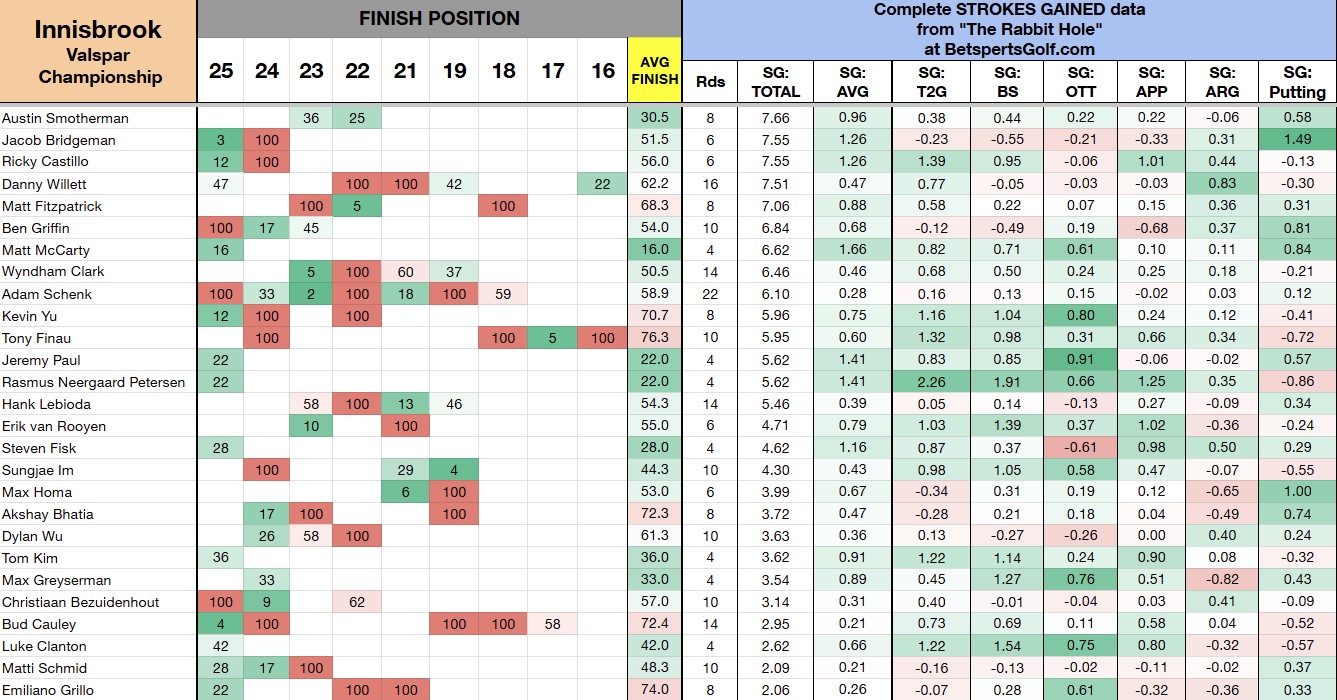
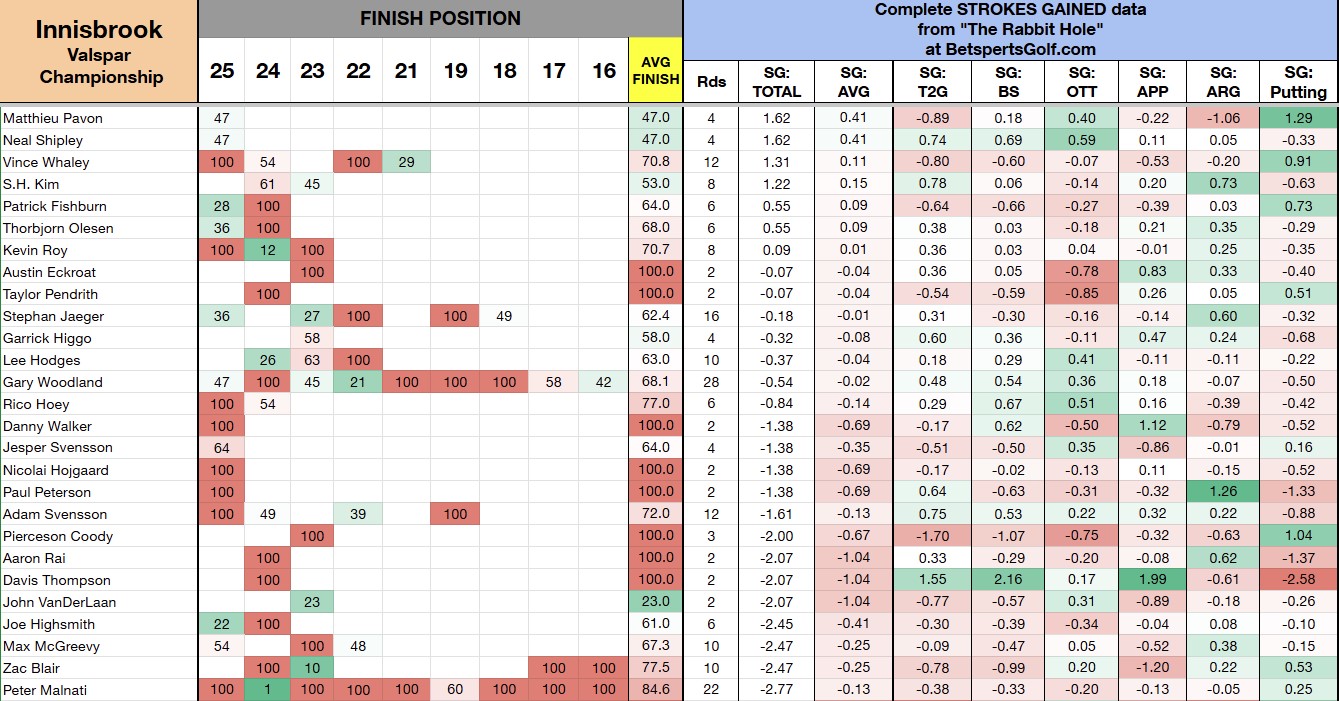
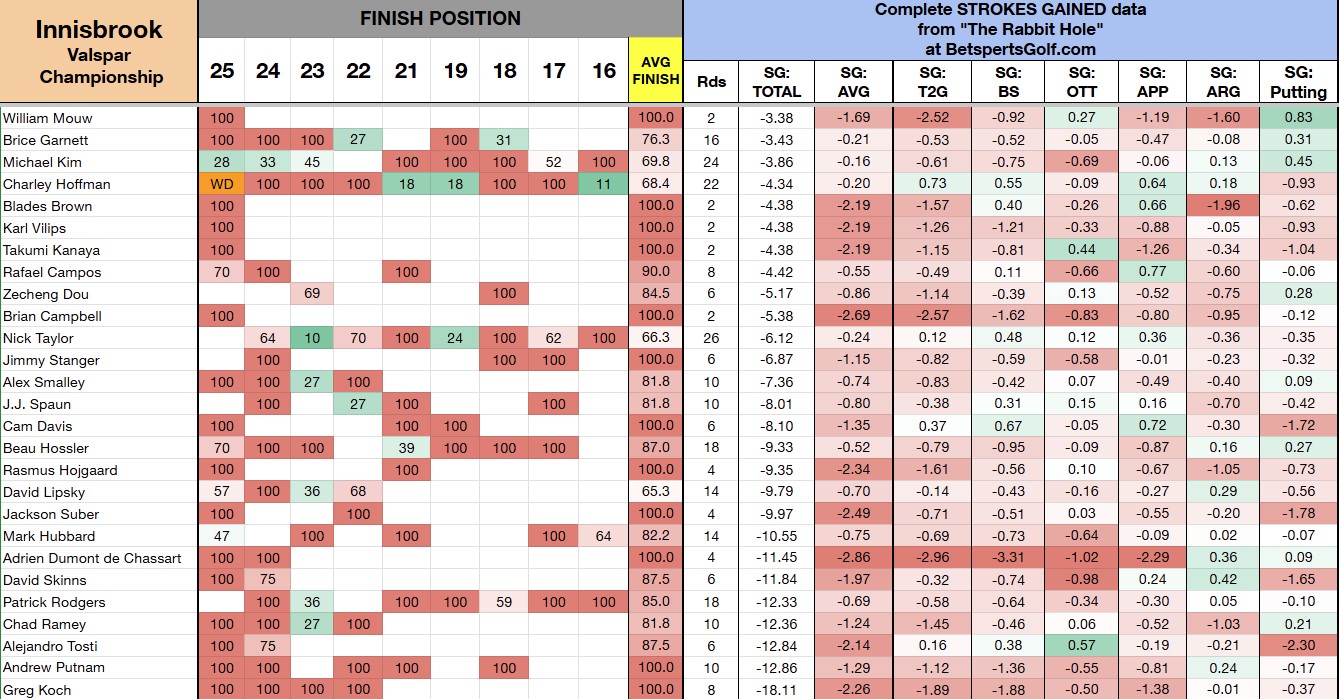
Finish Position and Strokes Gained History at Innisbrook Resort (2016-2025)
This includes the average finish position and Strokes Gained per round. Players are sorted by SG: Total. Innisbrook (Copperhead) is the 17th least predictive course on the PGA Tour. 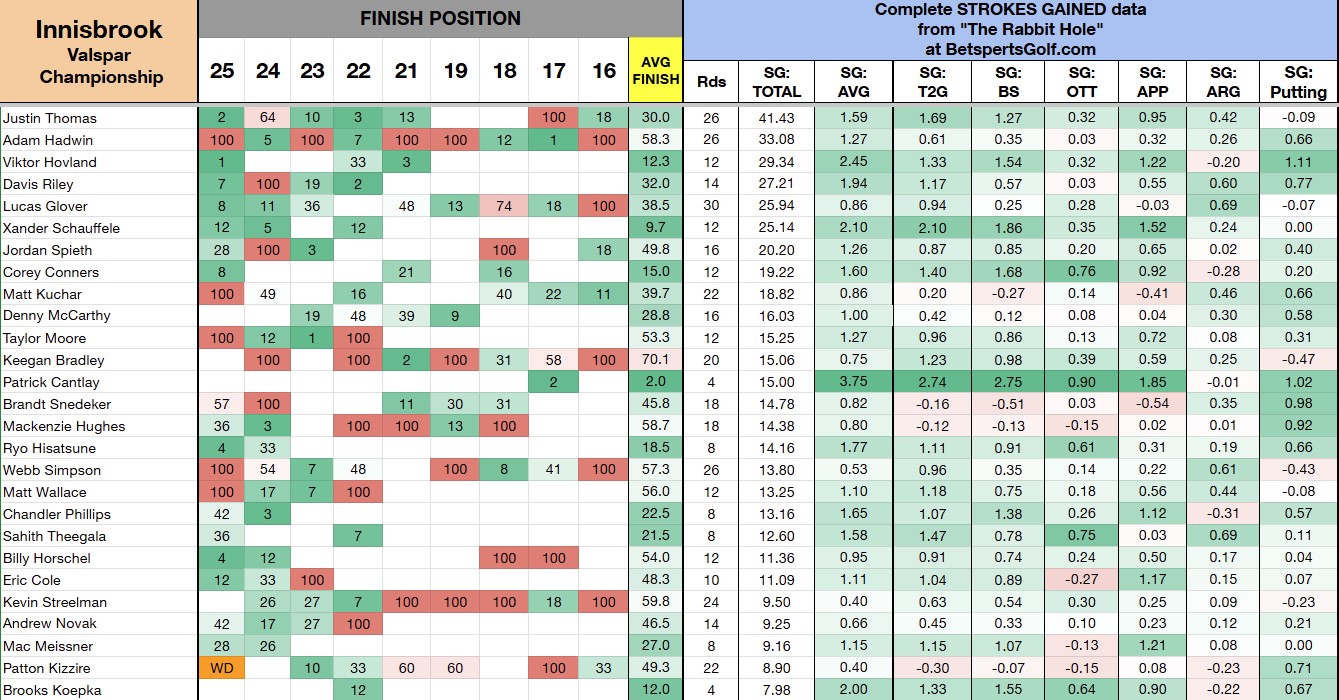
Course Features
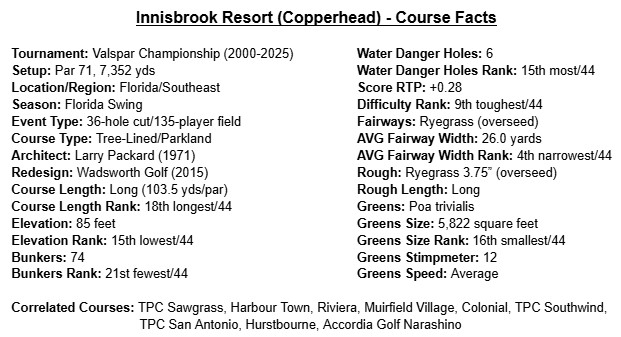
Sitting on a beautiful stretch of property on the Pinellas Peninsula, just minutes from the Gulf of Mexico near Tampa Bay, the Copperhead Course at Innisbrook Resort is a par 71 layout that measures 7,352 yards. With extremely tight fairways, numerous doglegs, and a majority of holes playing on the longer side, Innisbrook sets up as one of the most demanding courses players will face this year. With driver used on only 54 percent of tee shots, the course effectively plays even longer.
Innisbrook demands the ability to hit every type of shot. Said Zach Johnson on the equality of the course, “The beauty of this golf course is that we have seen individuals that hit it left-to-right, right-to-left, maul it and absolutely kill it, and guys that plot their way around. We’ve seen the Furyks win. Sean O’Hair hits it long. Paul Casey is not short. So we have seen every style of golf win here and that’s the beauty of a really good golf course. I feel like it separates and rewards quality golf.”
While the scoring environment can be challenging, with the winning score averaging 11 under par over the past dozen years, it is also considered a very fair test of golf. According to anonymous player surveys, it is one of the players’ favorite courses to compete on. Packard explained why he believed that was the case: “Copperhead is a tough golf course but it is fair. I designed it so that if you hit a good shot you will be rewarded. There are no gimmicks. I wanted you to have to use every club in your bag.” Scoring is so difficult here that the course has produced the second fewest eagles and the fewest birdies per 72 holes.
Along with tight fairways and several water hazards, the numerous elevation changes, tricky bunkers, and sloping greens all combine to make Innisbrook the demanding test that it is.
Jordan Spieth had this to say on the course in general. “It’s a very difficult golf course. Guys that come out and play well here are likely to play well on the harder courses and the bigger tournaments just because that kind of course suits their game more. You have to work the ball both ways here. It requires all sorts of shots, punch shots, launching it in the air, and obviously some discipline on the greens. It’s tough to hit the fairways and the greens. Greens in regulation will be a very important stat.”
There are several notable elevation changes from tee to green, both uphill and downhill. For example, the clubhouse sits on a hill, which means the first and tenth holes play downhill while the ninth and eighteenth climb back up toward the clubhouse. These undulations make distance control more difficult and often force players to deal with blind approach shots.
The course also uses doglegs on 12 different holes to force players to shape shots in both directions. It even features four double doglegs, which is a signature design element of Packard courses. NBC golf analyst Mark Rolfing once described it well by saying, “It’s a navigator’s course. You cannot overpower it. It’s all about the angles.”
The grass types this week are the same as those used last week at TPC Sawgrass. With the Bermuda grass still dormant, the fairways and rough are overseeded with rye, while the greens are overseeded with Poa Trivialis. As March progresses and temperatures warm, some of the Bermuda will likely begin to emerge beneath the overseed. The overseeded rough measures 3.75 inches. Beginning in 2023 and continuing this year, the intermediate cut of rough around the greens was reduced from 72 inches to 21 inches to bring the rough closer to the putting surfaces.
Hole Preview
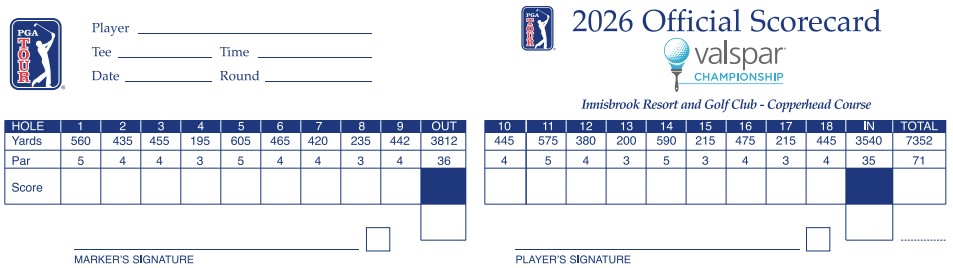
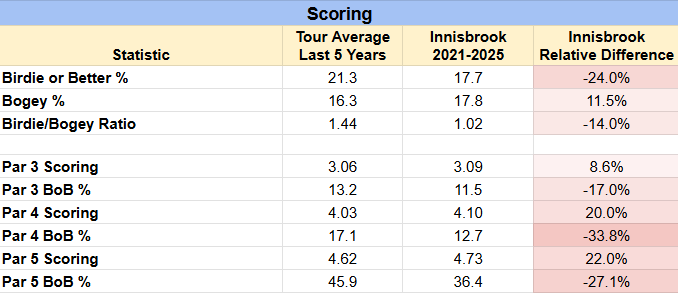
While there are six holes with water danger, there is nowhere close to the amount of risk/reward holes compared to TPC Sawgrass. In fact, as caddie Ted Scott said about Innisbrook, “To play good around here you’re going to have to play boring golf.” One unique aspect of this course is that there are five par-3s instead of the typical four. Each measures 195 yards or longer and they rank as the ninth most difficult group on Tour, averaging 3.10 strokes per hole. Each green is small and surrounded by thick rough or water. Those who can simply survive and avoid bogeys on this set of holes will have a huge advantage on the field.
Five of the par-4s play at 445 yards or longer. Most will force players to club down off the tee, leaving players with mid-to-long irons into small green complexes. The par-5s also rank as the fourth toughest on Tour, averaging 4.74 strokes. While they offer very few eagle opportunities, they are still the best option for making birdies as they are the only holes on the course that have historically played under par.
The closing stretch, known as the Snake Pit, is one of the most challenging on Tour. The 16th hole is a long par-4 with an extremely narrow fairway and water on one side. Following that is the 215-yard, par-4 17th that has a tiny green surrounded by bunkers and trees on both sides. The stretch concludes with the par-4 18th, which has one of the most difficult elevated sloping greens anywhere. All three holes feature over an 18% bogey rate and under a 10% birdie rate.
Strokes Gained Analysis
Off the Tee
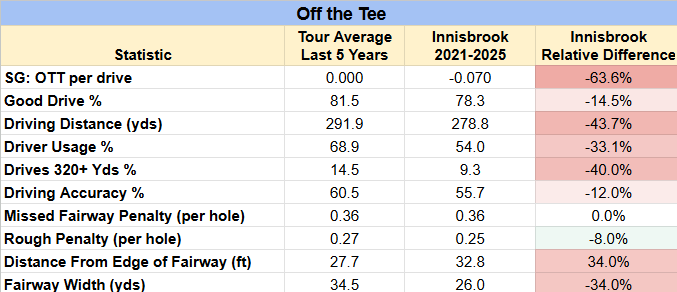
Off the tee, players hit fairways at a rate of only 55 percent. With landing areas averaging just 26 yards wide, they rank as the fourth narrowest on Tour. Because of this, along with numerous doglegs and forced layups that demand positional play, golfers use less than driver on 54 percent of tee shots. This leads to a significant drop in average driving distance to just 278 yards. Only Pebble Beach and Harbour Town feature a shorter average distance off the tee.
Ryan Moore once explained the challenge by saying, “I like that it has angles. There are not many simple tee shots on this golf course. There is always trouble, so you have to control the golf ball and shape it in the proper direction.”
Henrik Stenson echoed that sentiment, noting, “It is a course where you position yourself off the tee quite a lot. You often have to lay back unless you want to try threading a few of the tee shots. So there are quite a few two irons, four woods, and three woods off the tee.”
The fact that driving accuracy remains tougher than average even with players clubbing down shows how demanding Innisbrook is off the tee. Players who struggle with accuracy will often find themselves either in the thick rough or blocked by trees and forced to punch out. With bomb and gauge strategies proving ineffective and most players laying back to similar areas in the fairway, SG: Off the Tee becomes far less important compared to SG: Approach.
Although two of the last eight winners, Taylor Moore and Peter Malnati, ranked inside the top five in SG: Off the Tee for the week, the previous five winners averaged a ranking of 51st in that category, including Sam Burns in 2022 who ranked 104th after losing a full stroke off the tee. Eight of the last ten winners also finished outside the top 30 in driving accuracy for the week. Because nearly every player is following the same strategy of clubbing down, Innisbrook has become the toughest course on Tour for actually gaining strokes off the tee.
Approach
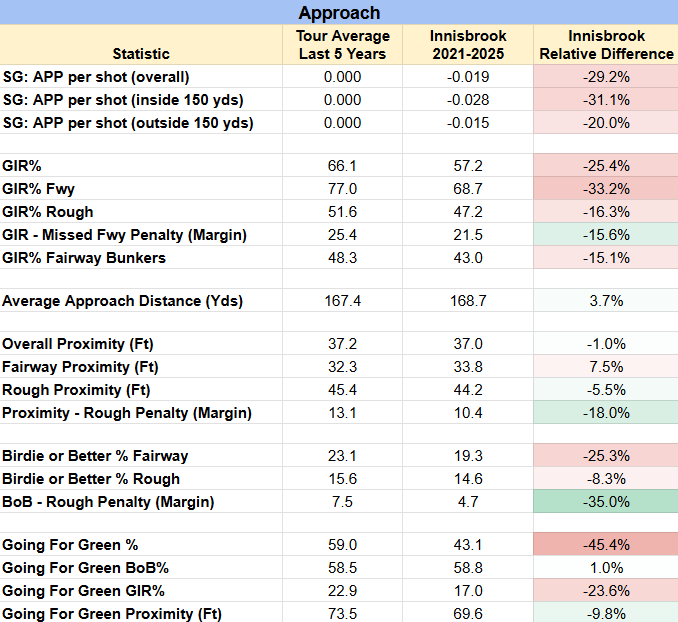
Innisbrook is annually one of the toughest courses to hit the green in regulation. Greens are typically firm, and the 57% GIR rate is one of the lowest on Tour. It is one of the most important courses to simply find the green on approach.
Said Bubba Watson who finished fourth here in 2019, “You have to pick and choose your battles. Around here it wasn’t so much of putting as it was hitting the greens in regulation. So try to hit fairways and hit wherever you can to get on the green. It’s about greens in regulation here.”
It is also the tenth-toughest annual course to gain strokes on approach. With greens smaller than average, firm conditions, tricky pin placements, and subtle undulations, proximity to the hole with longer irons is a challenge.
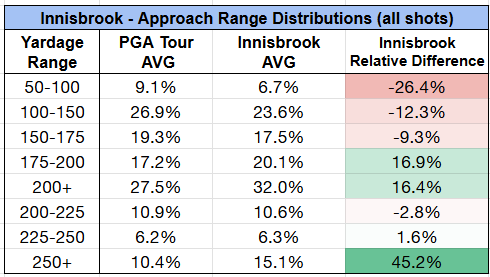
By sacrificing distance for accuracy off the tee, players will face approach shots from beyond 175 yards 53 percent of the time. They will need to be strong with their mid to long irons to have any chance of success. Approach play stands out as far more important than any other area this week, with the last six winners finishing at an average of sixth overall in that metric. Innisbrook is very much a true second shot course. It is also this combination of less than driver off the tee and long approach shots that makes Innisbrook one of the toughest scoring courses on Tour.
Around the Greens and Putting
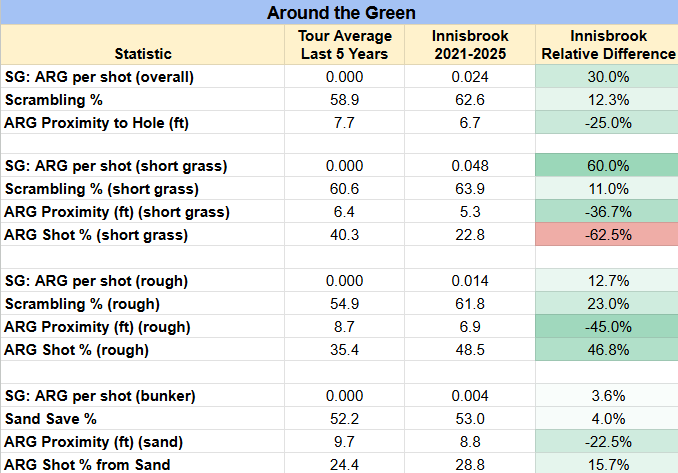
While Innisbrook has historically ranked on the easier side in strokes gained around the green, the past three years have gradually become more difficult because the thick rough was moved closer to the green surfaces. Scrambling from the rough has dropped from 65.9% in 2022 to 58.3% last year. With greens in regulation already low to begin with, players will need to rely heavily on their short game to save par.
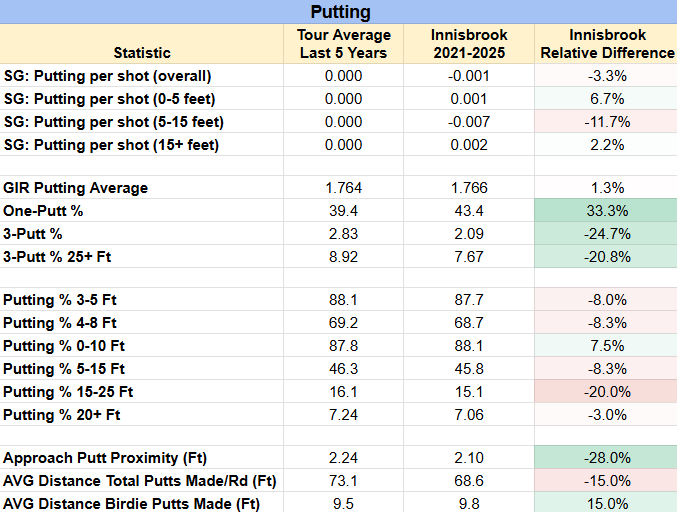
Although some of the greens feature tricky slopes, putting is generally easier than average in several categories. The one putt % is among the highest on Tour at 43%, while the three putt % is also among the easiest at just 2.23%. As Jordan Spieth explained, “The greens are not very severe here. They can be quick in certain places where they put the pins, but they are not the type of greens where you worry too much about speed control. You can be aggressive putting here, which is nice.”
Because the winning score is typically modest, the tournament does not usually turn into a putting contest where players must gain a large number of strokes on the greens to contend. That said, putting still plays an important role. 88% of the top 25 finishers in the last four tournaments here have gained strokes putting, and each of the last 14 winners has ranked inside the top 12 in putting for the week. The Poa Trivialis greens run around 12 on the stimpmeter and are considered some of the smoothest putting surfaces on Tour.
Most Important Stats For Success at Innisbrook
*In order of importance
- SG: APP
- DFEF (Distance From Edge of Fairway)
- Bogey Avoidance
- Scrambling
- Good Drive%
- SG: Par 5
- SG: Putting (Poa Trivialis/Bent)
- Proximity 175+ yards
- SG: OTT on Difficult OTT/Less Than Driver courses
- SG: Total (Difficult Scoring)
Key Rabbit Hole Filters
- Course Region: Florida
- Scoring Conditions: Difficult/Very Difficult
- Greens Surface: Poa Trivialis
- Rough Surface: Rye
- Rough Length: Long
- Gain OTT: Very Difficult
- OTT Club Type: Less Than Driver
- Fairway Accuracy: Difficult
- Missed Fwy Penalty: High
- Gain APP: Very Difficult
- GIR Accuracy: Difficult
- Par 5 Scoring: Difficult
- Scrambling Rough: Difficult
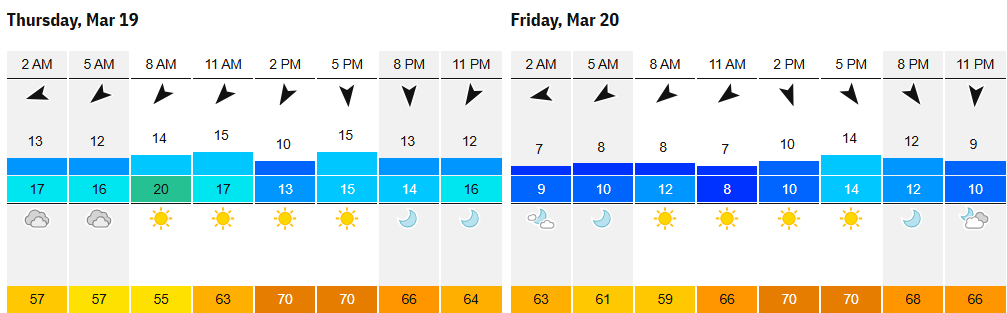
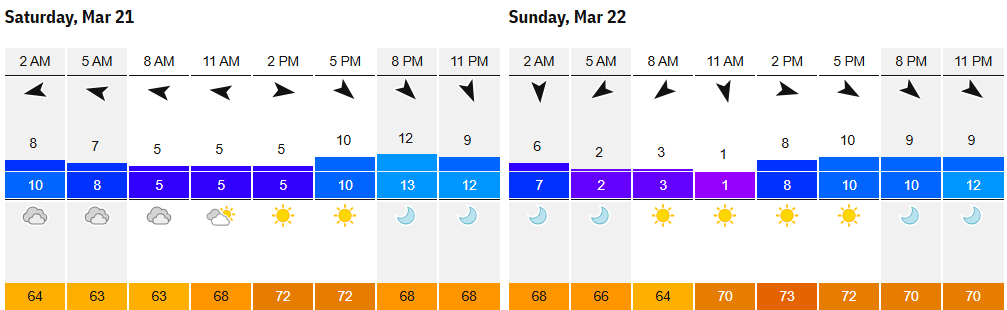
Weather Forecast – Palm Harbor, FL