Lookahead – 2025 The Open Championship at Royal Portrush Golf Club

Ron Klos

a year ago

Located in County Antrim, Northern Ireland, Royal Portrush will host the 153rd Open Championship from July 17-20. Considered one of the best courses in the world, it also has a reputation as one of the most challenging links courses in the United Kingdom. Designed by Harry Colt in 1929, it is an average-length par-71 track that measures 7,337 yards. 2024 Open Championship winner Xander Schauffele will look to defend his title.
In 1951, Royal Portrush first hosted the Open Championship, the oldest of golf’s major championships; it was the first Open tournament not held on the island of Great Britain. The Open returned in Portrush in 2019 where Ireland’s own Shane Lowry emerged victorious, winning his maiden title by six shots over England’s Tommy Fleetwood.
The course is full of spectacular dunes, dramatic elevation changes, and demanding holes. The course plays exactly like a traditional links track with excellent views of the coast throughout. Royal Portrush is also a very playable course. While there are a couple of blind shots, the course is mostly all in front of you. Wayward drives will be punished but not as much as some other links courses. The rough is penal and the effects of the wind can wreck a scorecard.
The fairways nestle in natural valleys between the towering sand dunes. The small greens blend perfectly into the landscape, one of Colt’s masterstrokes. The greens are mostly protected by natural grassy hummocks rather than sand bunkers
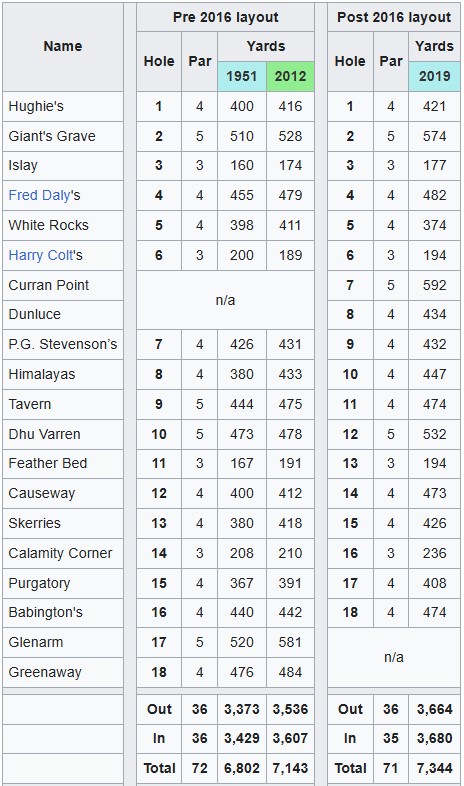
In preparation for the 2019 Open, architect Martin Ebert shifted numerous holes to make the course stronger. He added new seventh and eighth holes, fashioned from land on the club’s Valley Course to replace the weaker 17th and 18th holes. Ebert retained Harry Colt’s original greens which are considered among the best putting surfaces in the world.
There are several signature holes on both the front and back nine. The fourth hole is a long par four that measures 480 yards from the championship tees, with out-of-bounds to the right and thick rough on the left. There are several bunkers in the undulating fairway and the green is placed between two small sand hills.
The fifth hole is a relatively short downhill par four with a dogleg to the right. It has no bunkers but a heavily undulating green perched on the edge of a large drop down to the beach and has views across the White Rocks beach, and the Dunluce Castle after which the course was named.
The sixteenth hole, named Calamity Corner is a long 236-yard, uphill par three. It is played to a green over a huge ravine short and right, with mounds and hollows to the back and left of the green.
2025 Open Championship Odds