Lookahead – 2025 PGA Championship at Quail Hollow

Ron Klos

a year ago

The 2025 PGA Championship returns to the familiar territory of Quail Hollow Club in Charlotte, North Carolina from May 15-18. Having previously hosted the 2017 PGA Championship (won by Justin Thomas), the course has also recently been the home of the 2022 Presidents Cup. It also annually plays as the site of one of the most popular PGA Tour events, the Wells Fargo Championship.
Just southeast of downtown Charlotte, Quail Hollow Club has hosted a PGA Tour event each year since 2003. It is one of the most challenging courses on Tour averaging almost one stroke over par per round. Several players call Quail Hollow home, notably Webb Simpson, Mackenzie Hughes, Harold Varner, and popular analyst, Johnson Wagner. Rory McIlroy basically calls it home too, having won four times there.
Quail Hollow Club – History
Quail Hollow was laid out on what once was the largest dairy farm in North Carolina and was named for the plethora of quail that inhabited the property. Built on a 270-acre tract of land, architect George Cobb completed the course in 1961 intending to capture the beauty and natural terrain of the Piedmont region. It hosted the Kemper Open on the PGA Tour from 1969 through 1979 followed by the Senior Tour’s Paine Webber Invitational from 1983 through 1989.
Arnold Palmer helped to redesign the layout in 1986. Tom Fazio made further alterations in 1997 and again in 2003 to prepare the course for PGA Tour competition. The club stepped back into the limelight that year with the PGA Tour’s Wachovia Championship. Over time, it was renamed the Quail Hollow Championship and is now the Wells Fargo Championship.
From 2014 to 2016, in preparation for the 2017 PGA Championship, Fazio renovated much of the course including a complete rebuild of all 18 greens and converting the putting surfaces to Champion Bermuda turf. Tee boxes were shifted and more than 100 trees were removed to allow for more sunlight and clearer sight lines. Four holes were also significantly altered and lengthened to further strengthen Quail Hollow’s championship credentials. The club also hosted the 2022 Presidents Club in which the U.S. team soundly defeated the International team 17.5 to 12.5.
The Course
It is a classical parkland course that is a favorite among players. Along with immaculate conditions played on scenic rolling terrain, it’s known as one of the most pleasant walks in golf. The course has a natural flow as players step off one green and the next tee box is just yards away.
Every facet of a golfer’s game will be tested at Quail Hollow. As recent past winners demonstrate, including Wyndham Clark, Rory McIlroy, Max Homa, and Jason Day, distance off the tee and positive long iron play are especially advantageous. Another important skill that matters is scrambling for pars on some of the toughest green complexes that players will face all year.
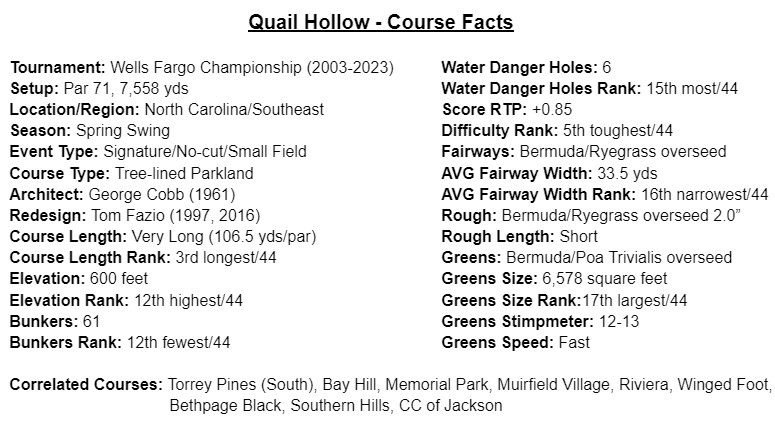
Measuring 7,558 yards, Quail Hollow is a tree-lined parkland par-71 layout. Similar to courses like Torrey Pines and Bay Hill, it presents a challenging combination of length and difficult scoring conditions. It is both the third longest and fifth toughest scoring course in the annual Tour rotation. It also has the sixth longest combined par 4s and par 5s on Tour.
There are five scoring holes at Quail Hollow – the three par 5s and the two semi-driveable sub-350 yard par 4s. To have success on this course, players will need to birdie as many of those as possible and then hold on for dear life on the other 13 holes which all average over par.
The course features tree-lined fairways, rolling terrain, strategically-placed water hazards, and firm undulating greens on approach. Though there are only 61 bunkers (12th fewest), they are well-utilized being laid out near landing zones along the fairways and often in the direct line of approach shots around the greens.
With a SubAir system below the greens, tournament officials gradually firm up the greens throughout the week so that by Sunday it becomes very tough to hold the green surface. This is another reason why long drivers of the ball have an advantage at Quail Hollow. More distance off the tee equates to higher-lofted and softer landing approach shots into firm tricky pin positions.
From an agronomic standpoint, the base turf at Quail Hollow is 100% bermudagrass. In the fall of each year, groundskeepers seed the course with bermuda, a warm-weather grass, and with rye, a grass meant for colder seasons. Right after the conclusion of the Wells Fargo Championship, a herbicide is used to kill the ryegrass and let the bermuda grow for the summer.
With Charlotte being in the mid-Atlantic region, the beginning of May is still too cool for the bermuda to completely break through the overseed. According to the Director of Green and Grounds, Keith Wood, the greens, approaches, tees and fairways are around a 50/50 mix of overseed and the underlying bermuda. The rough is 90% overseed.
The rough is ryegrass and will be grown out to a lush four-plus inches. The greens are typically on the faster side starting at around a 12 on the stimpmeter and increasing to a speedy 13 by Sunday’s final round. Greens are on the larger side averaging over 6,500 square feet bringing in scrambling and three-putt avoidance as other key stats this week.
Quail Hollow is perhaps best known for its three-hole closing stretch, the “Green Mile”. Each hole of the white-knuckle stretch features dangerous water hazards, strategically placed sand traps, tricky elevation changes, and firm undulating green complexes. Tour player, Brandt Snedeker said, “It’s got to be one of the toughest stretches in golf. There’s no bail-out on any of the holes. You just have to suck it up and get through it.”
“Those are three really brutal finishing holes,” Tour veteran Adam Scott said. “If you can survive those holes and win, you’ve certainly proved that to yourself because they’re so demanding. There is no breather.” The three holes have combined to play a staggering 0.27 strokes over par with a bogey-or-worse rate of 29.5% compared to a birdie rate of only 8.4%.
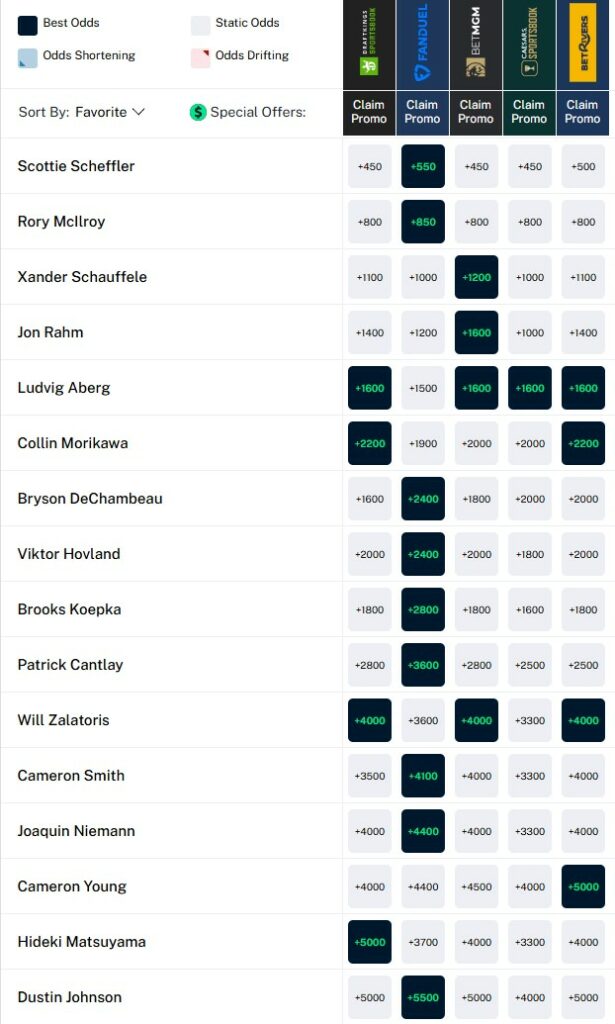
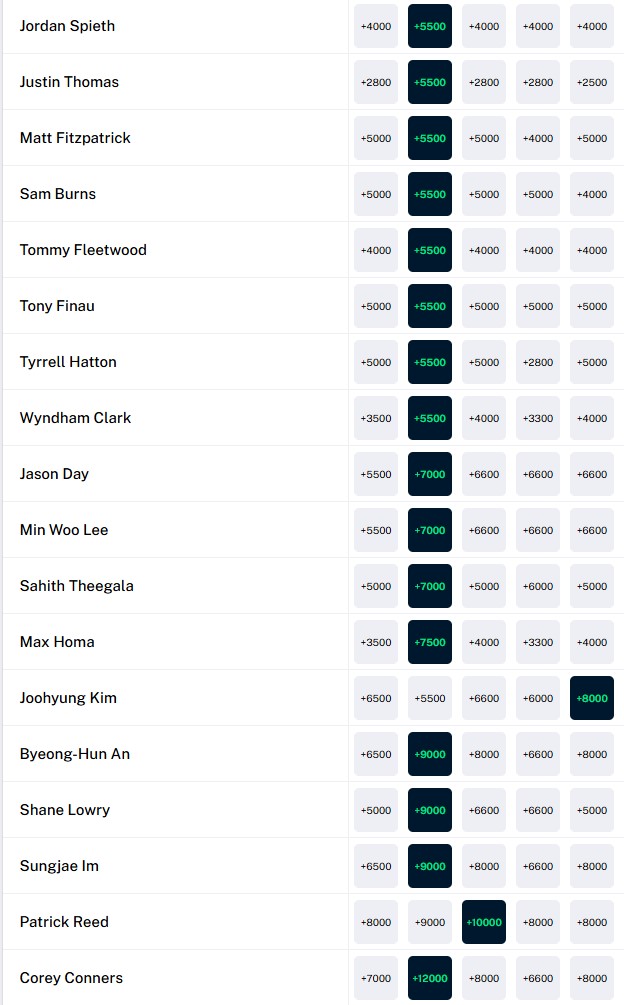
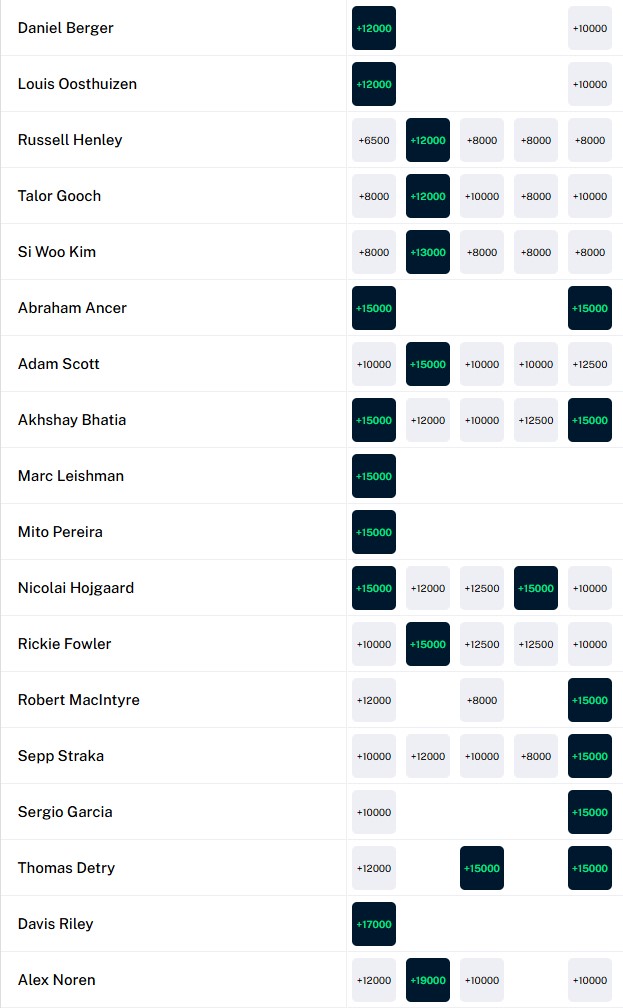
2025 PGA Championship Odds